Week 8: 2026’s Biggest Bullies
December 29, 2025College basketball efficiency rankings can be misleading. Some teams inflate their numbers by demolishing weaker opponents far beyond what statistical models predict, while simultaneously failing to meet expectations against quality competition.
This weekly feature identifies the biggest “bullies” in Division I basketball: teams whose efficiency metrics are artificially elevated by their performance against inferior opponents.
The rankings below count from #1 (biggest bully) to #25, highlighting teams that excel at padding stats against overmatched opponents while struggling to meet expectations against quality competition.

Figure 1: Top 10 teams with the highest bully scores in Week 8. Bully scores reflect the combination of overperformance against weak opponents and underperformance against quality competition.
#1: South Dakota St (7-7)
#174 South Dakota St was projected to beat #332 Georgia State by 10. They cruised to a 105-58 victory, 38 points better than projected. Against #98 Wyoming, South Dakota St lost 87-72. They were projected to win by 8.
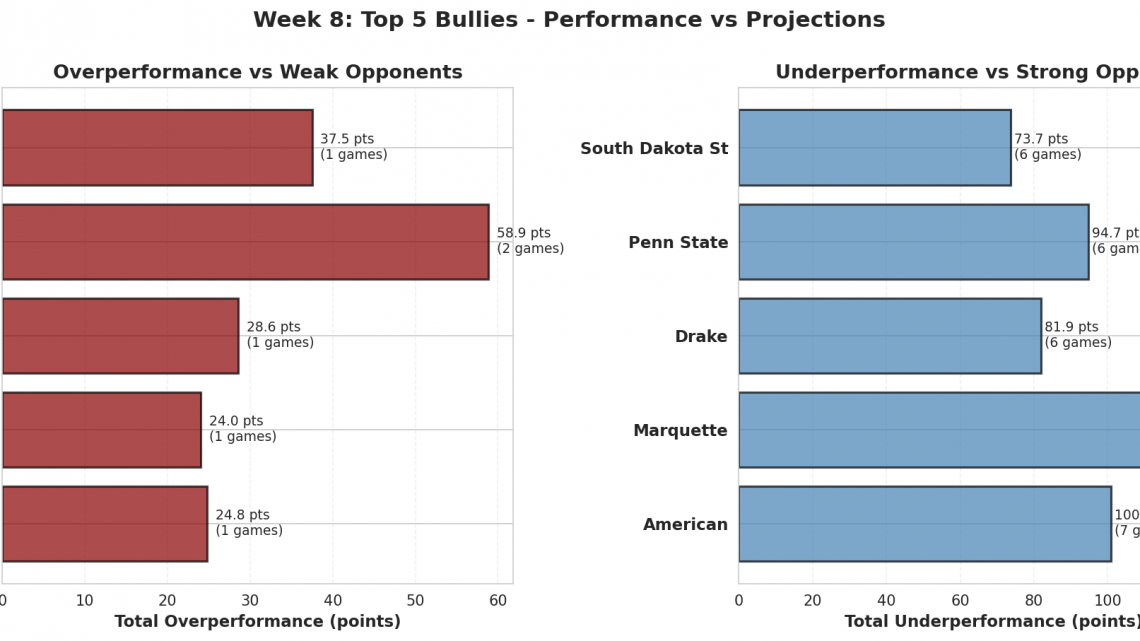
Bully Metrics: Exceeded projections by 37.5 total points against weak opponents (1 games); underperformed by 73.7 points against quality competition (6 games).
#2: Penn State (8-4)
Against #315 New Haven, #136 Penn State rolled to a 44-point win, 87-43. The model had them winning by 6; the actual margin was 44, outpacing the projection by 38. Facing #27 Indiana, Penn State came up short, losing 113-72 after being projected to lose by 1.
Bully Metrics: Exceeded projections by 58.9 total points against weak opponents (2 games); underperformed by 94.7 points against quality competition (6 games).
#3: Drake (7-6)
#139 Drake faced #359 Western Illinois as 22-point favorites and won handily 108-57, 29 points above the spread. Drake fell to #77 Murray State 81-72, missing the 12-point projection by 21.
Bully Metrics: Exceeded projections by 28.6 total points against weak opponents (1 games); underperformed by 81.9 points against quality competition (6 games).
#4: Marquette (5-8)
Expected to win by 16 over #338 Little Rock, #124 Marquette coasted to a 89-49 win—beating the line by 24. The model had Marquette winning by 6 against #27 Indiana. Instead, they lost 100-77.
Bully Metrics: Exceeded projections by 24.0 total points against weak opponents (1 games); underperformed by 131.8 points against quality competition (8 games).
#5: American (7-6)
#260 American won comfortably 92-66 against #282 Longwood. Favored by 1, the 26-point margin was +25 versus projection. Against #15 Virginia, American lost 95-51. They were projected to lose by 4.
Bully Metrics: Exceeded projections by 24.8 total points against weak opponents (1 games); underperformed by 100.8 points against quality competition (7 games).
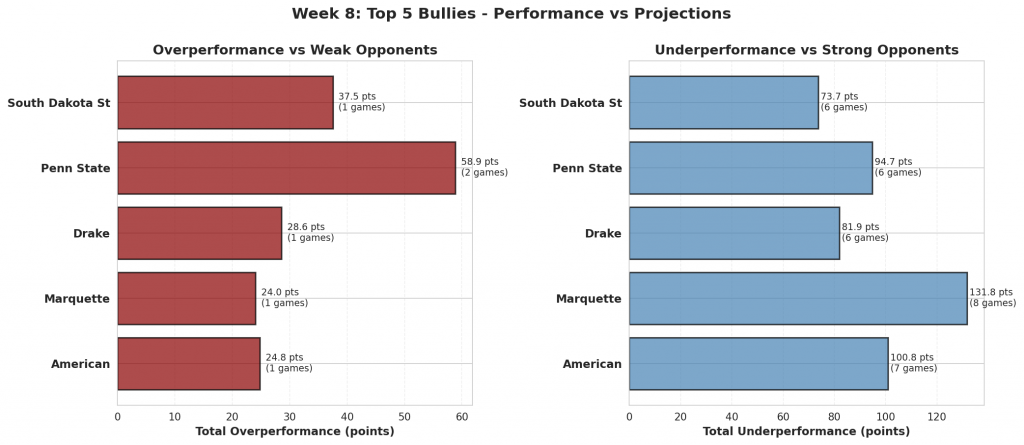
Figure 2: Performance comparison for the top 5 biggest bullies. Red bars show total overperformance against weak opponents; blue bars show total underperformance against strong opponents.
#6: High Point (12-3)
The model gave #60 High Point a 2-point edge over #331 Bryant. They rolled to a 46-point win, 93-47, finishing 44 beyond the expected margin. Facing #120 UAB, High Point came up short, losing 91-74 after being projected to win by 2.
Bully Metrics: Exceeded projections by 96.1 total points against weak opponents (4 games); underperformed by 29.6 points against quality competition (2 games).
#7: Queens University (5-7)
#188 Queens University handled #363 Gardner-Webb, winning 107-74. That 33-point margin was a 28-point swing from the projection. Queens University fell to #58 Wake Forest 111-73, missing the 9-point projection by 29.
Bully Metrics: Exceeded projections by 67.7 total points against weak opponents (3 games); underperformed by 78.9 points against quality competition (5 games).
#8: Drexel (6-7)
Facing #344 NJIT, #217 Drexel coasted to a 75-43 win. With a projected spread of 11, the result was 21 points past expectations. The model had Drexel losing by 2 against #70 Syracuse. Instead, they lost 80-50.
Bully Metrics: Exceeded projections by 21.4 total points against weak opponents (1 games); underperformed by 66.7 points against quality competition (4 games).
#9: Wake Forest (9-4)
#58 Wake Forest was projected to beat #228 Campbell by 10. They cruised to a 99-51 victory, 38 points better than projected. Against #14 Vanderbilt, Wake Forest lost 98-67. They were projected to win by 2.
Bully Metrics: Exceeded projections by 91.5 total points against weak opponents (3 games); underperformed by 52.3 points against quality competition (7 games).
#10: NC State (9-4)
Against #325 UNC Greensboro, #24 NC State rolled to a 46-point win, 110-64. The model had them winning by 1; the actual margin was 46, outpacing the projection by 45. Facing #32 Seton Hall, NC State came up short, losing 85-74 after being projected to win by 6.
Bully Metrics: Exceeded projections by 107.7 total points against weak opponents (3 games); underperformed by 17.5 points against quality competition (9 games).
#11: Hampton (6-7)
#268 Hampton faced #328 Loyola Maryland as 4-point favorites and controlled the game en route to a 93-71 victory, 18 points above the spread. Hampton fell to #15 Virginia 91-53, missing the 8-point projection by 30.
Bully Metrics: Exceeded projections by 18.2 total points against weak opponents (1 games); underperformed by 38.9 points against quality competition (2 games).
#12: Lindenwood (8-5)
Expected to win by 3 over #329 Northern Illinois, #227 Lindenwood coasted to a 99-64 win—beating the line by 32. The model had Lindenwood losing by 13 against #35 Saint Louis. Instead, they lost 109-66.
Bully Metrics: Exceeded projections by 47.7 total points against weak opponents (2 games); underperformed by 41.5 points against quality competition (3 games).
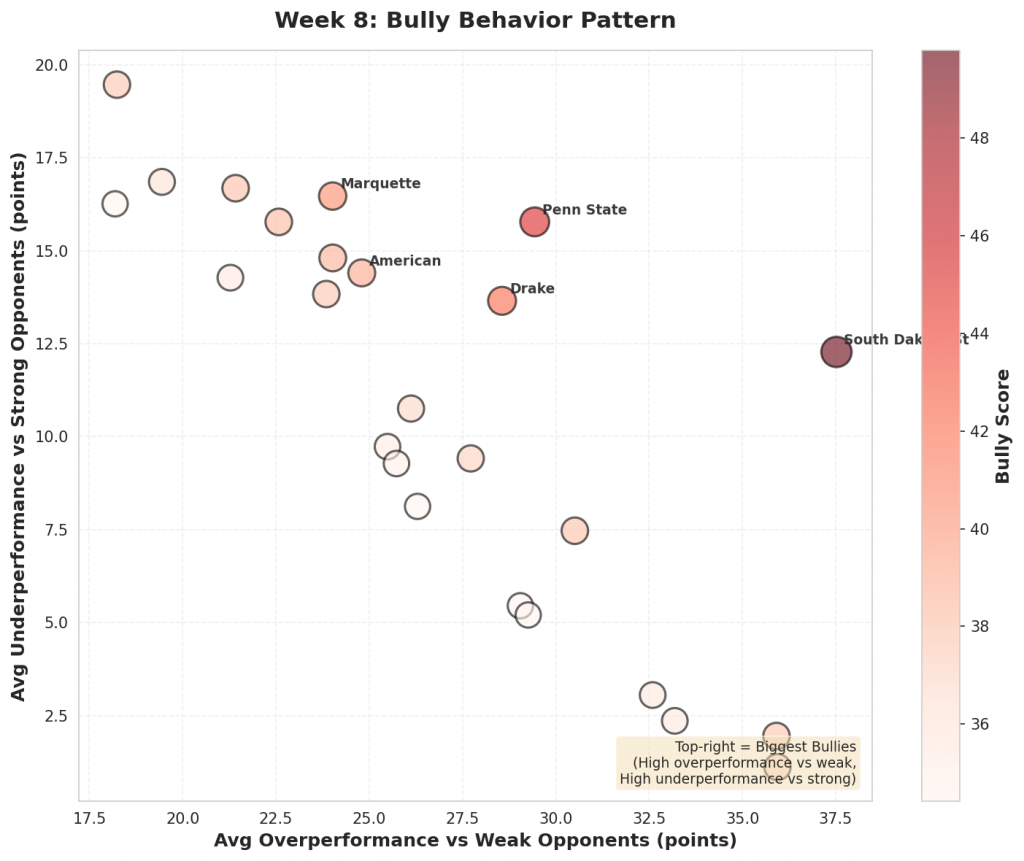
Figure 3: Scatter plot showing the relationship between overperformance against weak opponents (x-axis) and underperformance against strong opponents (y-axis). Bubble size and color indicate bully score magnitude. Top-right quadrant represents the biggest bullies.
#13: ETSU (8-5)
#119 ETSU cruised to a 97-55 victory against #340 UL Monroe. Favored by 14, the 42-point margin was +28 versus projection. Against #53 Dayton, ETSU lost 88-71. They were projected to lose by 6.
Bully Metrics: Exceeded projections by 27.7 total points against weak opponents (1 games); underperformed by 28.2 points against quality competition (3 games).
#14: Wyoming (9-3)
The model gave #98 Wyoming a 4-point edge over #278 Denver. They rolled to a 42-point win, 101-59, finishing 38 beyond the expected margin. Facing #125 Sam Houston, Wyoming came up short, losing 78-70 after being projected to lose by 2.
Bully Metrics: Exceeded projections by 71.9 total points against weak opponents (2 games); underperformed by 5.6 points against quality competition (5 games).
#15: Tenn Tech (6-7)
#312 Tenn Tech handled #288 West Georgia, winning 87-59. That 28-point margin was a 26-point swing from the projection. Tenn Tech fell to #21 Kentucky 104-54, missing the 25-point projection by 25.
Bully Metrics: Exceeded projections by 26.1 total points against weak opponents (1 games); underperformed by 53.8 points against quality competition (5 games).
#16: Missouri (10-3)
Facing #274 South Dakota, #93 Missouri coasted to a 102-68 win. With a projected spread of 12, the result was 22 points past expectations. The model had Missouri losing by 5 against #17 Illinois. Instead, they lost 91-48.
Bully Metrics: Exceeded projections by 77.8 total points against weak opponents (4 games); underperformed by 67.4 points against quality competition (4 games).
#17: Illinois (9-3)
#17 Illinois was projected to beat #362 Jackson State by 21. They cruised to a 113-55 victory, 37 points better than projected. Against #12 UConn, Illinois lost 74-61. They were projected to lose by 3.
Bully Metrics: Exceeded projections by 65.2 total points against weak opponents (2 games); underperformed by 30.5 points against quality competition (10 games).
#18: Dartmouth (5-6)
Against #241 Saint Peter’s, #230 Dartmouth pulled away for a 87-61 win. The model had them winning by 2; the actual margin was 26, outpacing the projection by 24. Facing #91 Marist, Dartmouth came up short, losing 75-56 after being projected to win by 0.
Bully Metrics: Exceeded projections by 42.6 total points against weak opponents (2 games); underperformed by 42.8 points against quality competition (3 games).
#19: Saint Louis (12-1)
#35 Saint Louis faced #277 Bethune-Cookman as 10-point favorites and won handily 112-53, 49 points above the spread. Saint Louis fell to #95 Stanford 78-77, missing the 11-point projection by 12.
Bully Metrics: Exceeded projections by 165.9 total points against weak opponents (5 games); underperformed by 11.8 points against quality competition (5 games).
#20: St Peter’s (5-5)
Expected to win by 2 over #343 Niagara, #241 St Peter’s took care of business, winning 71-43—beating the line by 26. The model had St Peter’s losing by 0 against #32 Seton Hall. Instead, they lost 77-50.
Bully Metrics: Exceeded projections by 25.5 total points against weak opponents (1 games); underperformed by 29.2 points against quality competition (3 games).
#21: Pitt (7-6)
#83 Pitt cruised to a 103-63 victory against #350 Binghamton. Favored by 14, the 40-point margin was +26 versus projection. Against #37 West Virginia, Pitt lost 71-49. They were projected to win by 2.
Bully Metrics: Exceeded projections by 51.5 total points against weak opponents (2 games); underperformed by 92.8 points against quality competition (10 games).
#22: Old Dominion (4-10)
The model gave #209 Old Dominion a 3-point edge over #360 Morgan State. They rolled to a 32-point win, 88-56, finishing 29 beyond the expected margin. Facing #96 George Washington, Old Dominion came up short, losing 96-73 after being projected to lose by 10.
Bully Metrics: Exceeded projections by 29.0 total points against weak opponents (1 games); underperformed by 43.6 points against quality competition (8 games).
#23: Gonzaga (13-1)
#2 Gonzaga handled #351 Southern Utah, winning 122-50. That 72-point margin was a 45-point swing from the projection. Gonzaga fell to #1 Michigan 101-61, missing the 1-point projection by 39.
Bully Metrics: Exceeded projections by 117.0 total points against weak opponents (4 games); underperformed by 46.8 points against quality competition (9 games).
#24: Wofford (8-5)
Facing #363 Gardner-Webb, #225 Wofford took care of business, winning 83-57. With a projected spread of 8, the result was 18 points past expectations. The model had Wofford winning by 3 against #121 Elon. Instead, they lost 73-52.
Bully Metrics: Exceeded projections by 18.2 total points against weak opponents (1 games); underperformed by 65.0 points against quality competition (4 games).
#25: Minnesota (7-5)
#102 Minnesota was projected to beat #345 Alcorn State by 10. They cruised to a 95-50 victory, 35 points better than projected. Against #4 Purdue, Minnesota lost 85-57. They were projected to lose by 11.
Bully Metrics: Exceeded projections by 105.2 total points against weak opponents (4 games); underperformed by 48.7 points against quality competition (6 games).
What This Means
These rankings highlight teams whose efficiency numbers may not tell the full story. While crushing inferior opponents is expected, doing so far beyond statistical projections while simultaneously underperforming against quality teams suggests inflated metrics.
Actionable Advice
- Safe Bets vs Weak Teams: These teams are “flat-track bullies”—they don’t let up. They are often safe bets to cover large spreads against inferior competition because they play hard for 40 minutes regardless of the score.
- Fade vs Strong Teams: Be extremely careful backing these teams against quality opponents. Their efficiency metrics are artificially inflated by their bully behavior, often leading to them being overvalued favorites against teams that can actually punch back.
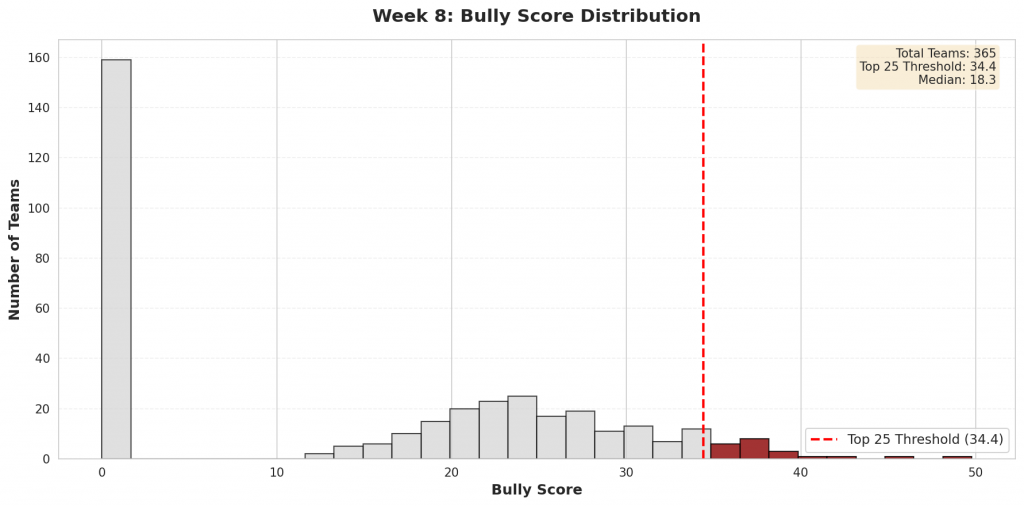
Figure 4: Distribution of bully scores across all Division I teams. The top 25 bullies (highlighted in red) represent teams whose efficiency metrics are most inflated by their performance patterns.
Check back next week for updated bully rankings.